Math basics are essential and you will be surprised how our homes are equipped to ensure that our kids acquire those math fundamentals.
1 FRACTIONs
10 year olds need to learn a lot about fractions. From basic fractions that are with common denominator they will go on to learn uncommon denominators and the use of fractions in various math operations.
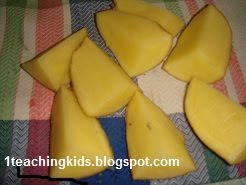
It was not easy for me when my son was just learning fractions. Drawing diagrams and using color just did not get it home with him. I sliced potatoes at first to show him what fractions meant.
Potatoes helped greatly and I also turned it into an art project! But potatoes did not help much when denominators and numerators differed and operations become complicated.
Cooking however is a very good method to teach fractions. How?
For simple fraction practice, simply follow a recipe.
For more advanced fraction, get your child to double or halve the recipe. Another practice is asking your child to figure out which measuring cups to use. For example, only make available a 1/4 cup measuring cup when baking a cake. Help your child figure out how many 1/4 cups go into each 1/2 and full cup. And so on.
Check my blog entry on Love Cookies to help with a quick recipe for giving your kids a lesson on fractions.
2 DECIMALS
Decimals is the other thing that 10 year olds need to learn. Teach decimals from basic fractions.
Children will also work with decimals with money. If you give your child an allowance, you may want to give slightly different amounts. Vary the practice. Ask your child to add the decimals or subtract.
You can also show your child how to compute the tip at restaurant, which will practice decimals.
Cooking is again an excellent method. Change the recipe to decimals. Give your child the measuring cups and so on and he will need to translate the decimals to fractions.
You can use the same principle for other math basics.
You can use the same principle for other math basics.
If you are looking for a book, try this one. Straight forward, it guarantees learning and if you dont like it just return it. And it does not cost very much - slightly less than US10
 Or you can Click Here! for more information.
Happy Cooking!